
How to read a Tesla part number: revision letters, what interchanges, and the exceptions
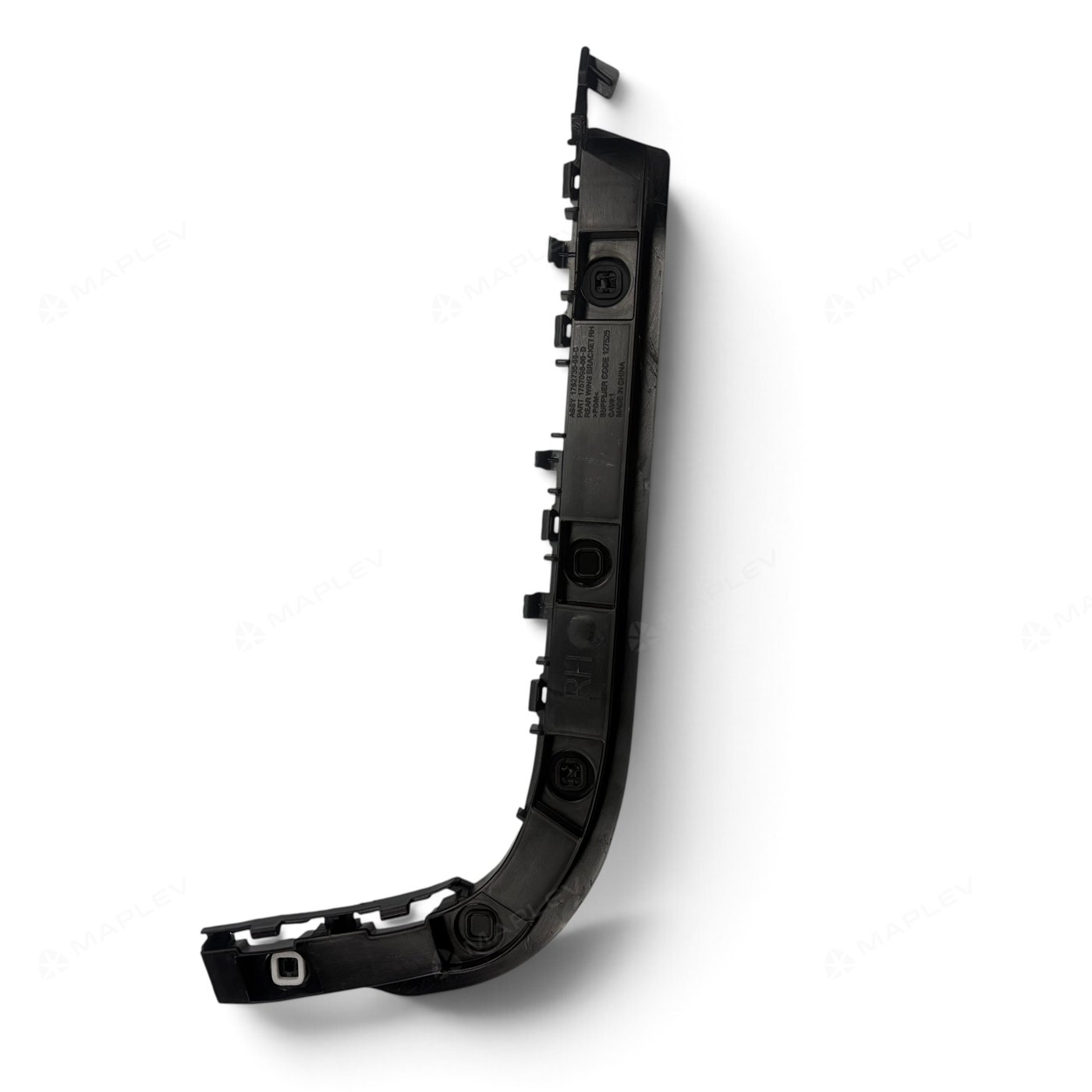
Short answer: read a Tesla part number as three blocks — for example 1084168-S0-E. The first 7 digits (1084168) are the base number that identifies the part and its position on the car. The middle block (S0, 00, E0…) marks a variant of that part. The final letter (-E) is an engineering revision: -A is the first release, -B the next, and so on. When an estimate shows -A but a supplier offers -D, that is normally the same part, several versions later.
How often does this come up? Constantly. In our published dataset (snapshot of 2026-08-29) we cross-reference 521 distinct Tesla OE numbers across the 287 collision and suspension parts in our catalog, and 116 of those part groups carry two or more revision letters of the same base number — a single wheel liner in our catalog spans -C, -D and -E, and a rear aero shield spans -D through -F. Revision letters in the catalog run all the way from A to L.
The three blocks, one by one
Base (7 digits) — identifies the part and its location. Everything with base 1084168 is the same front-bumper fascia family for the pre-Highland Model 3. When you search a supplier's catalog, search this block first: it survives every revision.
Middle code (2 characters) — distinguishes variants of that base part. Most numbers carry 00; you will also see codes such as S0, E0, SC and EC. Counted across the 521 distinct OE numbers in our catalogue: 428 carry 00, 15 carry S0, 12 carry E0, 9 carry SC and 9 carry EC. We report the counts without assigning meanings to the codes — we have not been able to source a definition of them to Tesla documentation. If the middle code differs between your estimate and the part offered, check what it denotes before assuming interchange.
Revision letter (final character) — the engineering version, issued in alphabetical order. Tesla supersedes numbers as parts are refined; the part's identity does not change. Across our catalog the distribution peaks at -A (113 numbers), -C (93) and -D (76), and stretches to -L — evidence of how actively Tesla revises.
The practical fitment rule
Match on the base number and treat the final letter as a version. Where the base and middle code line up, a later letter is commonly a newer version of the same part — which is why an estimate written against 1498771-00-D is often filled by a -E or -F of the same number. That is a search heuristic, not a guarantee: our data records that the variants exist, not that they interchange. Confirm the specific vehicle, VIN and Tesla EPC before ordering.
This is also how you should search. If an exact number returns nothing, drop to the 7-digit base: our cross-reference tool matches on the base as well as the full number, and each product page lists every revision and variant we have verified for that part.
The exceptions that actually bite
Connector changes hide behind lookalike numbers. The classic Model 3 example is tail lamps: outer lamps of different production runs use 3-pin and 4-pin connectors, and the change does not line up neatly with model years. Two lamps with near-identical numbers are not interchangeable across that split — count the pins on the car before ordering. Our tail-lamp product pages carry this warning for exactly that reason.
A different mold can hide behind a similar-looking application. On the Model 3 Highland, the standard front lower shield family (base 1694313) does not serve the Performance version, which uses a separate part with a different base number entirely (1818922 family). When trim levels differ, verify the base number rather than assuming one 'Highland part' covers all Highlands.
Electronics-adjacent parts deserve extra care. Anything that mounts a camera, radar or parking sensor can change hardware generations behind a revision letter. When the vehicle's production date sits near a hardware transition, confirm the sensor suite on the car first.
Regional numbers: the -CN- twist
Tesla's China-built cars carry some part numbers with a CN middle code that, in our own catalogue checks, did not resolve in the North American catalogue we searched. Because Canadian roads have plenty of these vehicles, an estimator will sometimes meet a number like 1619812-CN-A that a North American lookup can't resolve. Our catalogue records these as cross-references against the global number on the same listing, so either number finds the same product page — we record the pairing without asserting how Tesla defines the CN code.
If a number resolves nowhere, consider the China-market possibility before concluding the part doesn't exist: search the 7-digit base, and check whether the vehicle is a Shanghai-built unit (the VIN's 11th character reveals the plant).
A 60-second workflow for estimators
1) Take the OE number off the estimate or the part label. 2) Search the full number; if nothing returns, search the first 7 digits. 3) Confirm the middle code matches or is a documented variant. 4) Treat the revision letter as a version — later is normally fine. 5) For tail lamps, count connector pins; for trim-level-specific parts and sensor-adjacent parts, confirm against the car, not just the number.
Every product page on our site lists the full set of verified cross-references for that part — including revisions and, where they exist, China-market numbers — so one lookup shows you every number that estimate might have used.
Frequently asked
My estimate says -A but the supplier offers -D. Is that the same part?
Usually, but confirm it. The final letter is a revision issued alphabetically, and a later letter is commonly a newer version of the same part. Verify that the 7-digit base and the middle code match, then confirm the specific vehicle, VIN and Tesla EPC before ordering — a shared base is a strong search signal, not proof of interchangeability.
What do the 7 digits at the start of a Tesla part number mean?
They identify the part itself and its position on the vehicle — the part's stable identity. Revisions and variants change the trailing blocks, but the base digits survive, which is why base-number search is the most reliable way to find a Tesla part.
Are Tesla part revisions always interchangeable?
Usually, but not blindly. Known exceptions include Model 3 tail lamps (3-pin vs 4-pin connectors that don't follow model years — count the pins), trim-level splits like Highland Performance using a different base number for its front lower shield, and sensor-adjacent parts near hardware transitions.
What does a -CN- part number mean?
A -CN- code appears on a small number of entries in our catalogue. In our own checks those numbers did not resolve in the North American catalogue we searched. If a number won't resolve, search the 7-digit base as well, and confirm the part against the vehicle and Tesla's EPC before ordering.