
Tesla TPMS sensors for winter wheels: which cars, pairing, cost
Updated · Version française
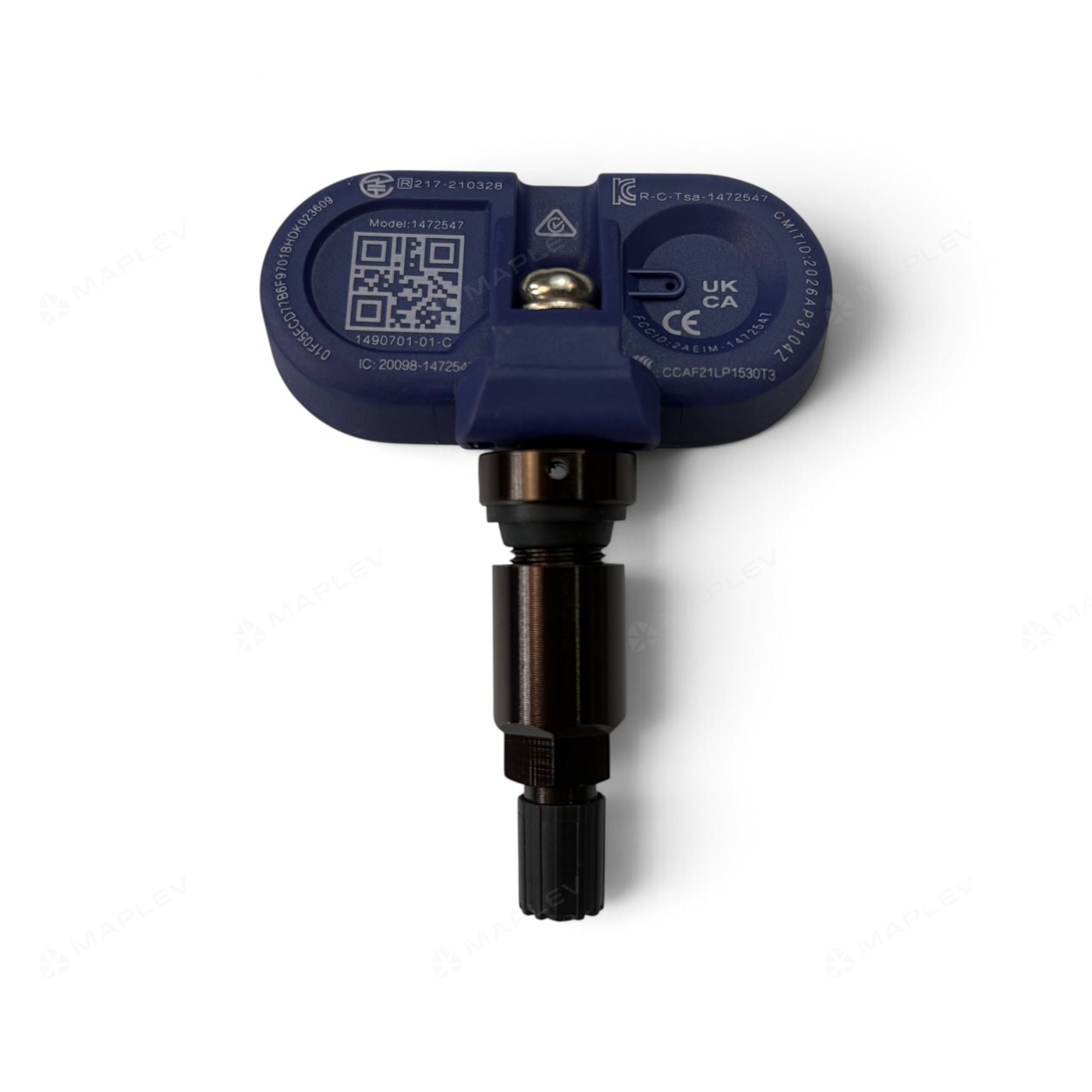
Short answer: a Tesla with direct tire pressure monitoring (TPMS) needs one sensor in each winter wheel, four in all. Tesla's Canadian shop lists its sensor for the Model Y and for the Model 3 built from 2021. Depending on how they were ordered, some newer Model 3 and Model Y have indirect TPMS instead: no sensors in the wheels, so their winter set needs none.
Our sensor is aftermarket, Bluetooth, listed under Tesla number 1490701-01-C (sensor model 1472547), with a 2-year warranty: CA$69 each, CA$276 for four. Winter tires are compulsory in Quebec from December 1 to March 15, and required on most British Columbia routes from October 1 to April 30.
Does your Tesla have TPMS sensors?
Tesla's owner's manuals for the 2024-and-later Model 3 and the 2025-and-later Model Y say that, depending on the configuration purchased, a car has direct TPMS, with a sensor in each wheel, or indirect TPMS, which estimates pressure loss and warns only when a tire is underinflated. To check, touch Controls > Service: if the picture of the car shows a pressure for each tire (psi or bar), it has direct TPMS.
Tesla's Model Y service manual names the Model Y Standard as an indirect TPMS car: a procedure released in December 2025 retrofits sensors to it. Tesla's Canadian shop lists its replacement sensor for Model Y vehicles and for Model 3 vehicles produced in 2021 or later. It does not list it for the 2017–2020 Model 3, and we do not stock a sensor for those cars.
| Car | Tire pressure monitoring | Sensors for a winter set |
|---|---|---|
| Model 3 built 2021–2023 | Direct | 4 (Tesla lists its sensor for Model 3 produced in 2021 or later) |
| Model 3 2024 and later | Direct or indirect, depending on the configuration | 4 with direct TPMS, none with indirect |
| Model Y | Direct, except configurations with indirect TPMS such as the Model Y Standard | 4 with direct TPMS (Tesla lists its sensor for Model Y vehicles), none with indirect |
| Model 3 built 2017–2020 | Direct | 4, but Tesla's current sensor is not listed for these cars, and we don't stock one |
Will new TPMS sensors pair by themselves?
Tesla's owner's manuals say that after one or more wheels are replaced (but not after replacing a tire), the TPMS sensors are relearned automatically once the car is driven over 25 km/h (15 mph): within two minutes on the Model Y, within 10 minutes on the Model 3. When you fit different wheels, also update the wheel choice under Controls > Service > Wheel & Tire > Wheels, so the car learns the new wheels.
Then watch the tire pressure light. When the system has a fault, the indicator flashes for about one minute and then stays on, at every start, and while it is on the car may not detect or signal low pressure. Tesla lists replacement or alternate tires and wheels that keep the TPMS from working among the causes, and says to check the light after every wheel or tire change.
If a sensor still does not connect, Tesla's service manual has a drive-learn procedure: in Service Mode, a technician erases all stored TPMS IDs, drives the car above 25 km/h to pair the sensors, and confirms that all four are connected. The owner's manual adds that if a shop other than a Tesla Service Center repairs or replaces a tire, the tire sensor may not work until Tesla performs the setup procedure.
Indirect TPMS: no sensors, but calibrate after the swap
On a car with indirect TPMS, Tesla's manuals ask for a manual calibration after the pressures are adjusted or the tires are changed, repaired or rotated. Set all four tires to the recommended cold pressure, then touch Controls > Service > Tire Pressure > Calibrate Tire Pressure. Calibration begins once the car is driven over 25 km/h, and finishes sooner with steady driving at higher speeds, without hard acceleration or stop-and-go traffic.
A Model Y Standard can be converted to sensors. In Tesla's retrofit procedure, a sensor goes into each of the four wheels on a tire machine, a technician switches the car to Bluetooth TPMS in Service Mode, and a road test above 20 mph (32 km/h) completes the learning.
How a shop fits a TPMS sensor
The sensor is mounted inside the wheel, so the tire comes off the rim. In Tesla's procedure the nut that holds the sensor to the wheel is tightened to 8 Nm (5.9 lbs-ft) with an 11 mm deep socket. Tesla's flat-rate time is 0.42 hour per sensor (correction code 34040202, Model Y 2025-and-later service manual). In December 2024 Tesla removed the separate step of programming the sensor ID from its 2017–2023 Model 3 procedure.
Tesla's service manual also notes that its updated sensor (black) performs and is serviced the same as the original (purple), and that the two can be fitted on different wheels of the same car. Tesla's shop sells its sensor one at a time, says four are needed for a set of four wheels, and asks you to pick the valve colour (black or silver) that matches the wheels.
Winter tire rules in Quebec and British Columbia
Quebec: winter tires are mandatory from December 1 to March 15 inclusive, and only studded tires and tires with the mountain-and-snowflake pictogram count as winter tires (SAAQ).
British Columbia: winter tires or chains are required on most routes from October 1 to April 30. On some highways that do not cross mountain passes or high-snowfall areas, the requirement ends March 31; the routes are marked with signs. On a passenger vehicle, a legal winter tire has at least 3.5 mm of tread and carries the M+S mark or the mountain-and-snowflake symbol, and chains or other traction devices are used with winter tires (BC government).
Tesla's manuals add: fit winter tires as a complete set of four at the same time, with the same diameter, brand, construction and tread pattern on all four wheels.
What TPMS sensors cost
Our Bluetooth sensor is CA$69 each, aftermarket, with a 2-year warranty: CA$276 for a set of four, before tax. It is listed for Model 3 (2021 – Dec 2023) · Model 3 Highland (Jan 2024–) · Model Y (Jan 2020 – Jan 2025) · Model Y Juniper (Feb 2025–); a car of those years that has indirect TPMS needs none.
Ships to any address in Canada by ground courier: about 2 business days to Alberta and Saskatchewan, 3 to Manitoba, 5 to Ontario and Quebec (business days, not counting weekends). Orders can also be picked up free at our Richmond, BC office.
Frequently asked
Do I need TPMS sensors in my Tesla winter wheels?
Yes, if the car has direct TPMS: one per wheel, four in all. Without them the tire pressure light signals a fault and the car may not warn you of low pressure. A Model 3 or Model Y with indirect TPMS has no sensors, so its winter wheels need none; calibrate the system after the swap.
Which TPMS sensor does a 2021+ Model 3 or a Model Y use?
With direct TPMS, a Bluetooth sensor; with indirect TPMS, none in the wheels. Tesla's Canadian shop lists its sensor for Model Y vehicles and for Model 3 vehicles produced in 2021 or later. Ours is aftermarket and listed under Tesla number 1490701-01-C (sensor model 1472547).
How do I pair new TPMS sensors on a Tesla?
Tesla's owner's manuals say the sensors are relearned automatically after the wheels are replaced, once the car is driven over 25 km/h: within two minutes on the Model Y and 10 minutes on the Model 3. If one does not connect, Tesla's service procedure erases the stored IDs in Service Mode and relearns all four on a drive above 25 km/h.
Why does my Tesla not show tire pressures?
It probably has indirect TPMS, which estimates pressure loss without sensors. Tesla's manuals say a pressure for each tire shows under Controls > Service only on cars with direct TPMS. Tesla's service manual has a procedure to retrofit sensors to the Model Y Standard.
When are winter tires required in Quebec and BC?
Quebec: December 1 to March 15 inclusive (SAAQ). British Columbia: October 1 to April 30 on most routes, and to March 31 on some highways outside mountain passes and high-snowfall areas.
How long does a shop take to fit a TPMS sensor?
Tesla's flat-rate time is 0.42 hour per sensor (correction code 34040202, Model Y 2025-and-later service manual). The tire has to come off the wheel.
Can black and purple Tesla sensors be mixed on one car?
Yes. Tesla's service manual says the updated black sensor performs and is serviced the same as the original purple one, and both types can be installed on different wheels of the same car.
Are your TPMS sensors genuine Tesla parts?
No. Ours is an aftermarket Bluetooth sensor listed under the Tesla number it replaces (1490701-01-C), with a 2-year warranty. Tesla sells its own sensor one at a time on its online shop.
Sources
- Tesla Model Y Owner's Manual (Canada) — Tire Care and Maintenance
- Tesla Model 3 Owner's Manual (Canada) — Tire Care and Maintenance
- Tesla Shop (Canada) — Model SX3Y Tire Pressure Monitoring System
- Tesla Model Y (2025+) Service Manual — Sensor - TPMS - Front - LH (Remove and Replace)
- Tesla Model Y (2025+) Service Manual, English (Japan) edition — Sensor - TPMS - Front - LH (correction code and flat-rate time)
- Tesla Model Y (2025+) Service Manual — TPMS (Sensor ID Drive Learn)
- Tesla Model Y (2025+) Service Manual — iTPMS to TPMS (Model Y Standard) (Retrofit)
- Tesla Model 3 (2017–2023) Service Manual — Sensor - TPMS (Remove and Replace)
- SAAQ — Winter Driving (winter tires mandatory December 1 to March 15)
- Government of British Columbia — Designated Winter Tire & Chain Routes
- Government of British Columbia — Passenger Vehicle: Tire and Chain Requirements